Minimally Invasive Surgery
Laparoscopic / Robotic surgeries are modern surgical techniques used to treat diseases of kidney, prostate & adrenal gland as well reconstructive urological conditions through small incisions instead of large open cuts.
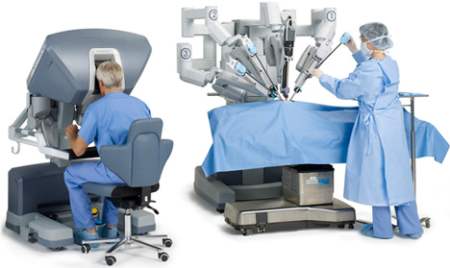
What is Laparoscopic Surgery?
Laparoscopy is a minimally invasive surgery performed using:
- Small incisions (usually 0.5-1 cm)
- A high-definition camera (laparoscope / telescope)
- Specialized long surgical instruments
The camera projects magnified images onto a screen, allowing the surgeon to operate precisely inside the body.
Unlike traditional open surgery, laparoscopy avoids large abdominal cuts.
How is Laparoscopic Surgery Different from Open Surgery?
| Open Surgery | Laparoscopic Surgery |
|---|---|
| Large incision | Small incisions |
| More blood loss | Less blood loss |
| Longer hospital stay | Shorter hospital stay |
| More pain | Less post-operative pain |
| Bigger scar | Smaller scars |
What is Robotic Urology Surgery?
Robotic surgery is a computer-assisted surgical technique where the surgeon controls robotic arms through a high-definition 3D console.
The robot does NOT operate on its own. The surgeon controls every movement.
The system allows:
- Magnified 3D vision
- Very precise instrument movements
- Smaller incisions
- Better access to deep pelvic organs
This technology is especially helpful in delicate surgeries such as prostate cancer removal.
How is Robotic Surgery Different from Laparoscopy?
Both are minimally invasive, but robotic surgery provides:
- Better 3D magnified visualization
- More precise wrist-like instrument movement
- Better nerve preservation
- Improved suturing accuracy
- Reduced blood loss in many cases
Conditions treated with Laparoscopy / Robotic Surgery in India
1. Kidney Tumors (Laparoscopic / Robotic Nephrectomy)
- Partial Nephrectomy (tumor removal while preserving kidney)
- Radical Nephrectomy (removal of entire kidney)
2. Prostate Surgery (Laparoscopic / Robotic Prostatectomy)
- Selected prostate enlargement cases
- Cancer-related procedures (depending on stage)
3. Bladder Cancer (Laparoscopic / Robotic Cystectomy)
- Removal of complete bladder with urinary diversion (Ileal Conduit)
4. Adrenal Tumors (Laparoscopic / Robotic Adrenalectomy)
- Removal of adrenal gland tumors
5. Pelviureteric Junction Obstruction (PUJO) (Laparoscopic / Robotic Pyeloplasty)
- Correction of kidney drainage obstruction (PUJ Obstruction)
6. Reconstructive Urology (Laparoscopic / Robotic)
- Ureter repair / Ureteroplasty
- Ureteric re-implantation
Benefits of Laparoscopic / Robotic Surgery
- Smaller incisions
- Reduced blood loss
- Less post-operative pain
- Short hospital stay (usually 2-4 days)
- Faster healing
- Early return to work
- Lower infection risk in many cases
- Better NVB preservation in prostate surgery (Robotic)
Is Laparoscopic / Robotic Surgery Safe?
Yes. Laparoscopic / Robotic surgery is widely practiced in India and considered safe when performed by trained surgeons in properly equipped hospitals.
Like any surgery, risks may include:
- Bleeding
- Infection
- Injury to surrounding organs
- Anaesthesia-related risks
Risk level depends on overall health, disease stage and complexity of the surgery.
Recovery after Laparoscopic / Robotic Surgery
Most patients:
- Start walking within 24 hours
- Resume light activities in 1-2 weeks
- Return to office work in 2-3 weeks
- Resume heavy work after medical advice
Recovery is generally faster compared to open surgery.
Frequently Asked Questions (FAQ)
1. Is Laparoscopic / Robotic surgery painful?
Pain is usually less compared to open surgery because incisions are smaller.
2. How long does Laparoscopic / Robotic surgery take?
Duration depends on the procedure performed and complexity of it.
3. How many days do I need to stay in hospital?
Most patients stay for 2-4 days depending on the procedure and recovery.
4. Is Laparoscopic / Robotic surgery better than open surgery?
For many urological conditions, Laparoscopic / Robotic surgery offers faster recovery and smaller scars. However, suitability depends on the individual case.
5. Is Laparoscopic / Robotic surgery available in Pune / Pimpri-Chinchwad?
Yes. Advanced Laparoscopic / Robotic surgeries are available in selected hospitals in Pune / Pimpri Chinchwad.
6. Can elderly patients undergo Laparoscopic / Robotic surgery?
Yes, if they are medically fit. Age alone is not a contraindication. Fitness for anaesthesia and overall health are evaluated first.
7. What are risks of Laparoscopic / Robotic Surgery?
Risks may include bleeding, infection, urine leakage or injury to nearby organs. These risks are generally low when performed by experienced surgeons.
8. Is Laparoscopic / Robotic surgery covered by insurance in India?
Most health insurance companies cover Laparoscopic procedures if medically necessary. Coverage depends on the individual insurance policy.
9. When is open surgery preferred instead of Laparoscopy / Robotic surgery?
Open surgery may be required in very large tumors, advanced cancers, or complex emergency situations where minimally invasive approach is not suitable.
10. Does the robot perform surgery automatically?
No. The surgeon controls every movement. The robotic system assists with precision and stability.
11. What are side effects after robotic prostate surgery?
Urinary leakage and erectile dysfunction may occur. Many patients recover gradually over time. Outcome depends on cancer stage & nerve preservation.
12. How long will the catheter remain after robotic / laparoscopic prostate surgery?
Usually 7-14 days, depending on healing and surgical findings.
13. How do I know if I need robotic surgery?
You require proper consultation with Urologist (Urosurgeon) and further evaluation.